 Add to Chrome
 Add to Firefox
 Add to Edge
DocRetriever: A Plug-and-Play Framework for Multimodal Document Retrieval with Comprehensive Benchmark
May 28, 2026
Multimodal documents contain diverse elements, such as tables, figures, and layouts, which can complicate retrieval tasks. While current approaches typically combine dense visual embedding models with supervised rerankers to achieve high-precision retrieval, they face inherent limitations. First, the coarse-grained nature of dense embeddings tends to obfuscate explicit semantics, failing to leverage structurally salient information. Second, supervised reranking models suffer from generalization bottlenecks, as their performance heavily relies on domain-specific training data. Furthermore, existing benchmarks often lack diverse assessment dimensions and comprehensive relevance annotations, limiting reliable evaluation. To address these challenges, we propose DocRetriever, a plug-and-play framework. It enhances visual retrieval via a layout-aware sparse embedding technique, enabling effective hybrid encoding without the overhead of optical character recognition (OCR). We also introduce a generalizable reranker that leverages reasoning-augmented demonstrations and optimized sampling to improve accuracy in few-shot settings. Finally, we construct a new benchmark, MultiDocR, to enable more rigorous evaluation. Experiments across diverse benchmarks validate DocRetriever's superiority over state-of-the-art methods.

Diffusion Model as a Generalist Segmentation Learner
Apr 27, 2026Diffusion models are primarily trained for image synthesis, yet their denoising trajectories encode rich, spatially aligned visual priors. In this paper, we demonstrate that these priors can be utilized for text-conditioned semantic and open-vocabulary segmentation, and this approach can be generalized to various downstream tasks to make a general-purpose diffusion segmentation framework. Concretely, we introduce DiGSeg (Diffusion Models as a Generalist Segmentation Learner), which repurposes a pretrained diffusion model into a unified segmentation framework. Our approach encodes the input image and ground-truth mask into the latent space and concatenates them as conditioning signals for the diffusion U-Net. A parallel CLIP-aligned text pathway injects language features across multiple scales, enabling the model to align textual queries with evolving visual representations. This design transforms an off-the-shelf diffusion backbone into a universal interface that produces structured segmentation masks conditioned on both appearance and arbitrary text prompts. Extensive experiments demonstrate state-of-the-art performance on standard semantic segmentation benchmarks, as well as strong open-vocabulary generalization and cross-domain transfer to medical, remote sensing, and agricultural scenarios-without domain-specific architectural customization. These results indicate that modern diffusion backbones can serve as generalist segmentation learners rather than pure generators, narrowing the gap between visual generation and visual understanding.
DUET: Joint Exploration of User Item Profiles in Recommendation System
Apr 15, 2026Traditional recommendation systems represent users and items as dense vectors and learn to align them in a shared latent space for relevance estimation. Recent LLM-based recommenders instead leverage natural-language representations that are easier to interpret and integrate with downstream reasoning modules. This paper studies how to construct effective textual profiles for users and items, and how to align them for recommendation. A central difficulty is that the best profile format is not known a priori: manually designed templates can be brittle and misaligned with task objectives. Moreover, generating user and item profiles independently may produce descriptions that are individually plausible yet semantically inconsistent for a specific user--item pair. We propose Duet, an interaction-aware profile generator that jointly produces user and item profiles conditioned on both user history and item evidence. Duet follows a three-stage procedure: it first turns raw histories and metadata into compact cues, then expands these cues into paired profile prompts and then generate profiles, and finally optimizes the generation policy with reinforcement learning using downstream recommendation performance as feedback. Experiments on three real-world datasets show that Duet consistently outperforms strong baselines, demonstrating the benefits of template-free profile exploration and joint user-item textual alignment.
Generative Reasoning Recommendation via LLMs
Oct 23, 2025Despite their remarkable reasoning capabilities across diverse domains, large language models (LLMs) face fundamental challenges in natively functioning as generative reasoning recommendation models (GRRMs), where the intrinsic modeling gap between textual semantics and collaborative filtering signals, combined with the sparsity and stochasticity of user feedback, presents significant obstacles. This work explores how to build GRRMs by adapting pre-trained LLMs, which achieves a unified understanding-reasoning-prediction manner for recommendation tasks. We propose GREAM, an end-to-end framework that integrates three components: (i) Collaborative-Semantic Alignment, which fuses heterogeneous textual evidence to construct semantically consistent, discrete item indices and auxiliary alignment tasks that ground linguistic representations in interaction semantics; (ii) Reasoning Curriculum Activation, which builds a synthetic dataset with explicit Chain-of-Thought supervision and a curriculum that progresses through behavioral evidence extraction, latent preference modeling, intent inference, recommendation formulation, and denoised sequence rewriting; and (iii) Sparse-Regularized Group Policy Optimization (SRPO), which stabilizes post-training via Residual-Sensitive Verifiable Reward and Bonus-Calibrated Group Advantage Estimation, enabling end-to-end optimization under verifiable signals despite sparse successes. GREAM natively supports two complementary inference modes: Direct Sequence Recommendation for high-throughput, low-latency deployment, and Sequential Reasoning Recommendation that first emits an interpretable reasoning chain for causal transparency. Experiments on three datasets demonstrate consistent gains over strong baselines, providing a practical path toward verifiable-RL-driven LLM recommenders.
DSI-Bench: A Benchmark for Dynamic Spatial Intelligence
Oct 21, 2025Reasoning about dynamic spatial relationships is essential, as both observers and objects often move simultaneously. Although vision-language models (VLMs) and visual expertise models excel in 2D tasks and static scenarios, their ability to fully understand dynamic 3D scenarios remains limited. We introduce Dynamic Spatial Intelligence and propose DSI-Bench, a benchmark with nearly 1,000 dynamic videos and over 1,700 manually annotated questions covering nine decoupled motion patterns of observers and objects. Spatially and temporally symmetric designs reduce biases and enable systematic evaluation of models' reasoning about self-motion and object motion. Our evaluation of 14 VLMs and expert models reveals key limitations: models often conflate observer and object motion, exhibit semantic biases, and fail to accurately infer relative relationships in dynamic scenarios. Our DSI-Bench provides valuable findings and insights about the future development of general and expertise models with dynamic spatial intelligence.
Vela: Scalable Embeddings with Voice Large Language Models for Multimodal Retrieval
Jun 17, 2025Multimodal large language models (MLLMs) have seen substantial progress in recent years. However, their ability to represent multimodal information in the acoustic domain remains underexplored. In this work, we introduce Vela, a novel framework designed to adapt MLLMs for the generation of universal multimodal embeddings. By leveraging MLLMs with specially crafted prompts and selected in-context learning examples, Vela effectively bridges the modality gap across various modalities. We then propose a single-modality training approach, where the model is trained exclusively on text pairs. Our experiments show that Vela outperforms traditional CLAP models in standard text-audio retrieval tasks. Furthermore, we introduce new benchmarks that expose CLAP models' limitations in handling long texts and complex retrieval tasks. In contrast, Vela, by harnessing the capabilities of MLLMs, demonstrates robust performance in these scenarios. Our code will soon be available.
Observe-R1: Unlocking Reasoning Abilities of MLLMs with Dynamic Progressive Reinforcement Learning
May 18, 2025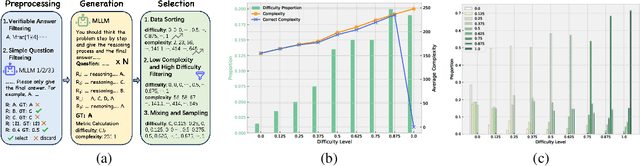
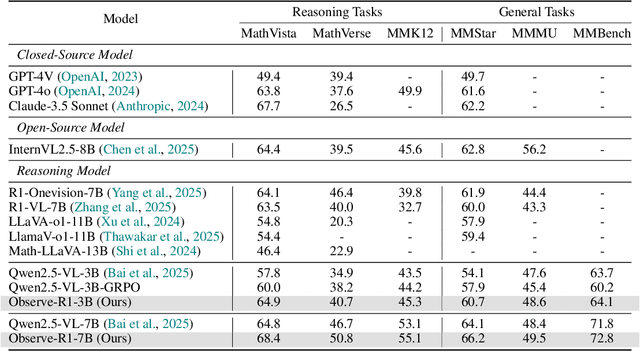
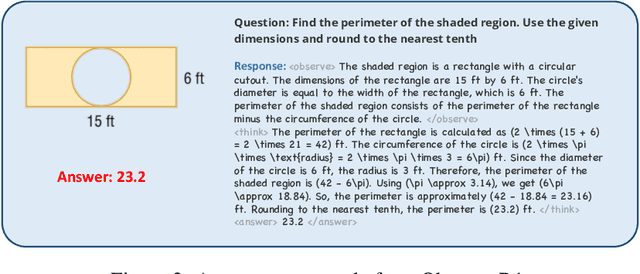
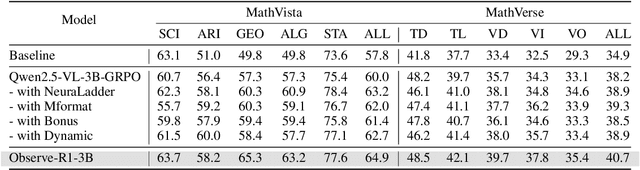
Reinforcement Learning (RL) has shown promise in improving the reasoning abilities of Large Language Models (LLMs). However, the specific challenges of adapting RL to multimodal data and formats remain relatively unexplored. In this work, we present Observe-R1, a novel framework aimed at enhancing the reasoning capabilities of multimodal large language models (MLLMs). We draw inspirations from human learning progression--from simple to complex and easy to difficult, and propose a gradual learning paradigm for MLLMs. To this end, we construct the NeuraLadder dataset, which is organized and sampled according to the difficulty and complexity of data samples for RL training. To tackle multimodal tasks, we introduce a multimodal format constraint that encourages careful observation of images, resulting in enhanced visual abilities and clearer and more structured responses. Additionally, we implement a bonus reward system that favors concise, correct answers within a length constraint, alongside a dynamic weighting mechanism that prioritizes uncertain and medium-difficulty problems, ensuring that more informative samples have a greater impact on training. Our experiments with the Qwen2.5-VL-3B and Qwen2.5-VL-7B models on 20k samples from the NeuraLadder dataset show that Observe-R1 outperforms a series of larger reasoning models on both reasoning and general benchmarks, achieving superior clarity and conciseness in reasoning chains. Ablation studies validate the effectiveness of our strategies, highlighting the robustness and generalization of our approach. The dataset and code will be released at https://github.com/zrguo/Observe-R1.
EAGER-LLM: Enhancing Large Language Models as Recommenders through Exogenous Behavior-Semantic Integration
Feb 20, 2025Large language models (LLMs) are increasingly leveraged as foundational backbones in the development of advanced recommender systems, offering enhanced capabilities through their extensive knowledge and reasoning. Existing llm-based recommender systems (RSs) often face challenges due to the significant differences between the linguistic semantics of pre-trained LLMs and the collaborative semantics essential for RSs. These systems use pre-trained linguistic semantics but learn collaborative semantics from scratch via the llm-Backbone. However, LLMs are not designed for recommendations, leading to inefficient collaborative learning, weak result correlations, and poor integration of traditional RS features. To address these challenges, we propose EAGER-LLM, a decoder-only llm-based generative recommendation framework that integrates endogenous and exogenous behavioral and semantic information in a non-intrusive manner. Specifically, we propose 1)dual-source knowledge-rich item indices that integrates indexing sequences for exogenous signals, enabling efficient link-wide processing; 2)non-invasive multiscale alignment reconstruction tasks guide the model toward a deeper understanding of both collaborative and semantic signals; 3)an annealing adapter designed to finely balance the model's recommendation performance with its comprehension capabilities. We demonstrate EAGER-LLM's effectiveness through rigorous testing on three public benchmarks.